

Have you ever wondered what your risk is for developing heart disease? Well, there are calculators out there to tell you, but they’re missing something that could be helpful: how much mental health disorders impact this risk. Sara Siddiqi is looking to fix this by using in-depth, Canadian research data to create a calculator that includes mental health disorders when calculating the risk of heart disease. For patients, this could mean earlier interventions and better care.
For her exciting research in the fields of epidemiology, mental health, and cardiology, Sara, a PhD candidate at the University of Ottawa and The Ottawa Hospital, and soon to be Dr. Siddiqi, is the 2026 recipient of the Grimshaw Researcher in Training Award.
Find out more about Sara’s research, why she chose to pursue epidemiology research, and why she’s passionate about equity, diversity, and inclusion (EDI).

I was born and raised in Ottawa, and I have always been someone who enjoys the outdoors. I have lots of great memories of going to parks with my siblings and friends. We liked making chalk hopscotches around our street and one time we made one with 1,000+ steps! I was always super into math, science, and reading. I really enjoyed exploring the local museums and picking up new books at the library. I also learned to skate at a young age.
I was always drawn to the fields of medicine and teaching. And my friends tell me I make a great study group leader. Research is the best of both worlds, and I get to apply a passion for doing work that supports others.
I had an interest in mental health and neuroscience from personal experiences with family members, and navigating the healthcare system.
Then, during my undergrad, I started volunteering in a neuroscience lab, where I was mentored by grad students. I never thought of research as a career until I saw these grad students doing really cool work. I saw how research was much more than following a protocol to do an experiment, it was asking questions, finding the best methods, going through trial and error, thinking, reflecting, and then thinking more, and then finding an answer to the original question, along with asking many more questions. I found it really rewarding to do this work in the field of mental health to help answer questions I knew others around me could benefit from.
In high school, I did a few science fair projects. I really enjoyed those and knew I wanted to be involved in research.
In my first year of undergraduate studies in Health Sciences at Carleton University, I researched the gut-brain axis and then explored a variety of topics throughout my degree. My fourth-year undergraduate thesis was on environmental enrichment and sex differences in neuroplasticity in mouse models, and in my Master of Science in Neuroscience, I studied ethno-racial differences in Parkinson’s disease.
My favourite parts of all these projects were doing statistical analysis and thinking about the application of the results. During my master’s, I learned about prediction modelling, and I found it really cool that we could use existing data to predict health outcomes. This was my opening to want to learn more about prediction models and different types of analyses, which I did while studying epidemiology at the University of Ottawa (uOttawa).
The focus of my research is to better predict a person’s risk of heart disease by considering mental disorders. There are calculators used by family doctors for estimating a person’s risk of developing heart disease in the future, and these calculators include risk factors like smoking, diabetes etc. But they don’t usually include mental health disorders.
Research has shown that mental health disorders can increase the risk of heart disease by two times, so by not considering these in a calculator, we may not be predicting risk accurately. It’s really important to consider the brain and heart together, and providing care for one without considering the other is not ideal as these systems impact each other. My PhD research aims to advocate for this connection, allowing people to receive better care.
This award is for the first part of my PhD, which was about finding out how existing heart disease calculators are developed, looking at how mental health has been considered, and benefitting from that, to inform our next work. Essentially, we reviewed all the existing calculators in this field and found when mental health disorders are considered, most only consider depression and anxiety, but they don’t look at more severe mental health conditions, which are more strongly associated with increased risk, like bipolar disorder, etc. This represents a big gap in the existing research. We also saw the calculators have limitations in their statistical analysis. Together, this can impact calculator accuracy and applicability to different populations.
The calculator that is currently used by Canadian family doctors was developed using US data from decades ago, and it underrepresents certain groups. We are now working on developing a new calculator using a Canadian dataset and informing the methods by our review. Our calculator aims to consider sex, socioeconomic status, and mental health disorders in predicting heart disease risk.
Our hope would be to more accurately identify patients for heart disease preventative care. This could be primary care doctors recommending lifestyle modifications, or having patients start preventative care medication. When we accurately predict someone’s risk, we’re setting them up for better healthcare quality. Unfortunately, people with mental health conditions are often missed in receiving care for other medical conditions. This work advocates for a holistic approach. Our discussions with patients with lived and living experience have shown appreciation and enthusiasm for this approach and research, and it’s really great to hear that our work is impactful.
While I was doing my master’s at Carleton, I joined the Faculty of Science’s EDI committee. There, I helped develop a toolkit for EDI in research: from hiring to incorporating intersectionality in your research questions, the whole spectrum. And at Carleton, I helped develop a mentoring program where you have a peer a couple years above you to talk about anything related to representation, someone who could just be a safe space.
As a visible minority, I often found myself not well represented in academia. I kind of decided to flip the narrative and convinced myself that maybe I could be the representation for others. Initially, that’s why I got involved in these initiatives, but then I ended up really loving it and enjoying the impact I could have. It felt rewarding for myself, but also people told me, “Wow, this is cool. This is helpful for me.” And I ended up finding a lot of passion being involved in EDI initiatives.
Now, during my PhD, I’m on the Brain-Heart Interconnectome (BHI) initiative’s IDEAS committee at uOttawa, to support inclusion, diversity, accessibility, and equity principles.
It’s really important to consider factors of intersectionality and different lived experiences and perspectives in research because it makes research stronger. Research that is derived from a variety of perspectives, and is inclusive, is more generalizable to the public. If we only consider one perspective when designing our research questions, then the answers we get will only be for that one audience. Incorporating EDI is a core principle of all my research projects, leadership, and community advocacy, and my hope is that others see the importance of this lens as well!
I think one of the big things that’s currently happening is the integration of artificial intelligence (AI) across research fields. Specifically on the topic of risk calculators, AI is something that can be used to make implementation of prediction models easier, or even quicker. I’m excited to see this field grow.
It’s such an honour. When I found out, I was speechless. It’s inspiring, and it motivates me to continue doing this work.
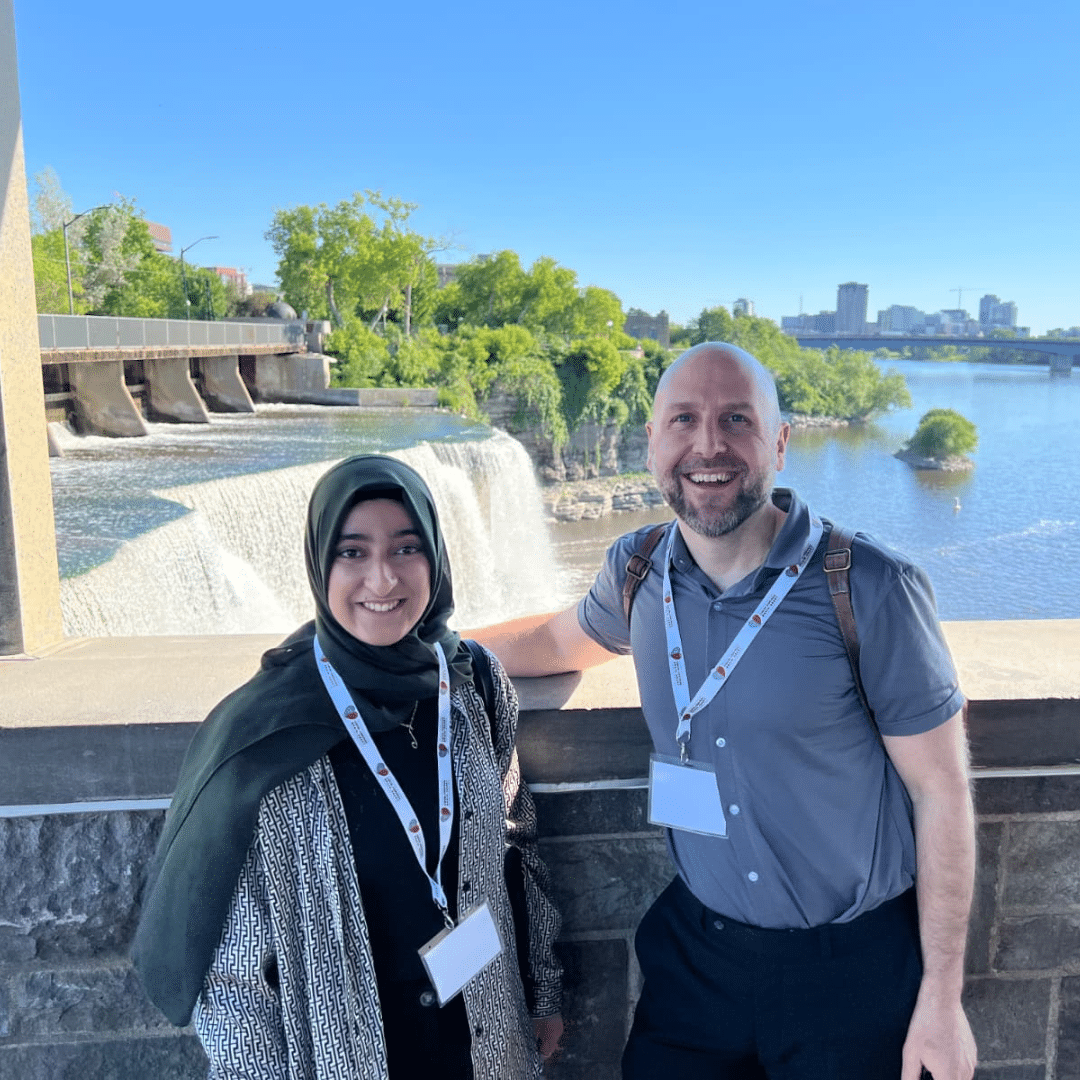
I have been very fortunate to have many mentors. A lot of the people around me have great skills and qualities I can learn from. In my growth as a researcher and in leadership positions my PhD supervisor Dr. Jess Fiedorowicz has been a great mentor. He truly leads by example, is incredibly supportive, and has taught me that leadership is about lifting up others and creating opportunities for them to grow as well. Along with my great co-supervisor, Dr. Ian Colman, and my first academic mentor and undergraduate/master’s research supervisor, Dr. Natalina Salmaso, they have all played an important role in my development. In addition to this, I have learned from many of the graduate students around me throughout my training, my friends, my mom, and my uncles!
Lincoln Lawyer! I’ve always been a fan of mystery books and TV shows. It’s kind of like research; we use data (the mystery evidence) to answer questions.
I didn’t know I had this fear till I had to face it: a squirrel making a nest in the hood of my car. I think that definitely classifies as an unusual fear.
I had a gymnastics phase and have performed mat routines in school shows!
At the rink, skating! In the winter on the canal/outdoor rinks, and in the summer at the local arenas! Or I might be café hopping with friends, going on a hike, travelling, or biking with my brothers. On the travelling side, I love seeing mountains, and recently I visited the Dolomites in Italy!


