

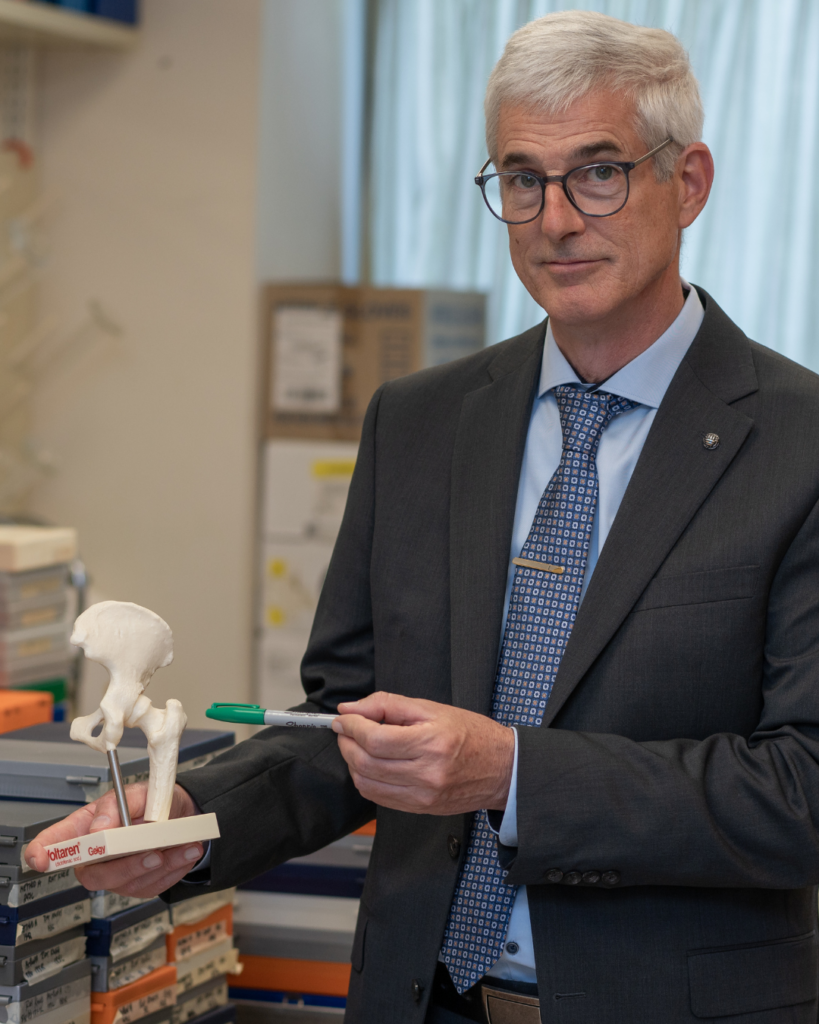
Not many scientists can say their research could have profound impacts all over our planet, and even off it, but Dr. Guy Trudel has always been one to explore new frontiers — even the final one. The physician and researcher at The Ottawa Hospital studies the effects of immobility on the musculoskeletal system, which includes experiments on astronauts in space.
His research may reach for the stars, but his day-to-day work is firmly grounded in patient care. When he’s not leading research studies, you can find Dr. Trudel working directly with patients at the Rehabilitation Centre, helping them recover from life-altering health challenges.
Discover what space travel has taught Dr. Trudel about the human body, how he became interested in this field of research in the first place, and whether he’d ever go to space himself.
Were you interested in science and medicine in your early years?
In school, not specifically. I was trying to succeed in a lot of different subjects. But I was quite curious. Whenever something would break at home, I would take it apart to see why and then put it back together. A toaster, a TV, a bicycle — whatever it was. Today we have YouTube for everything, but in those days, it was discovery.
I was also always trying to explore unknown places. I lived in a northern suburb of Quebec City, and I would take my bike as far as I could, going a little farther each time.
When did you realize you wanted to pursue medicine?
I never thought of doing medicine when I was young. I was on a university tour, trying to decide what to do next, and I had picked out three choices … none of which were medicine. During the tour, I heard a lot of buzz around people going into medicine, and I jumped out of my tour and went to the medicine one. There was a moment, listening to a speech by a faculty member in medicine, that I fell in love with it. I said, “This is where I want to go.”
What drew you to physical medicine and rehabilitation specifically?
In my second year of residency, so again, maybe late compared to my peers, I selected the speciality for a few reasons. First, I used to be an athlete, and it involved a lot of sports-related musculoskeletal medicine.
Second, I wanted to do research, and to do that, it helps to be in a speciality where your patients do not urgently need you, so you can free yourself to go and work in your lab.
And finally, physical medicine is one of the rare specialities where you treat the whole person — them, their entire family, and even the environment around them. People come in at a moment of crisis, everything is crumbling, and you help give them a new life and show them how to continue. And this is extremely rewarding.
What exactly does the clinical side of your role entail?
When patients come to us, whether they’ve been burned or in a car accident or acquired other catastrophic injuries, they’ve often been in the hospital for many weeks. Many can’t get out of bed on their own. We help them start from scratch, step-by-step, to return them to functioning in their community.
It involves a lot of teamwork — physiotherapy, occupational therapy, nursing, psychology, nutrition, social work etc. We help patients find ways of using what they have as opposed to focusing on what they lost.
What motivated you to pursue the research side, as well?
Discovery. Getting to the frontiers of what’s known and seeing what’s on the other side.
How did you end up doing space travel–related research?
My research is on people who are immobile, either in the ICU or paralyzed, and who cannot move. A major complication is that when the joints don’t move for weeks or months, you get what’s called a contracture, which is a permanent stiffness of the joints. After spending time in the ICU, about a third of patients will have contractures.
I wanted to conduct human research on immobility, but each patient was so different it was challenging. I thought that if I could just have one group of patients who were similar, I could do a lot with that research.
Then, right before I was about to go on a holiday, I was copied on an email from the Canadian Space Agency about a European model called a bedrest study that mimics space travel by putting people in bed for 60 days and measuring everything. They were looking for ideas on what they should measure and study. This was the model I wanted! I spent my whole vacation writing our application. We were one of about 10 studies of 100-plus selected.
Our experiments got very good results, and we found things that had never been found before.
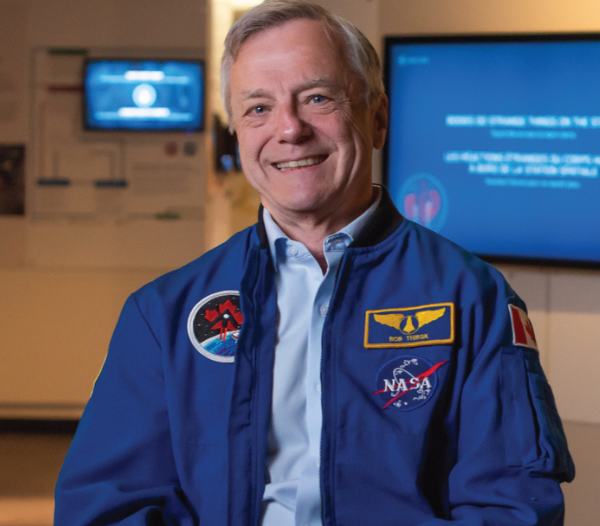
After that, we were approached to run experiments in space, and that’s how we ran the MARROW study. It looked at “space anemia,” or how bone marrow and the red blood cells it produces change in space. We recruited 14 astronauts going to space for six months, and we took measures before, during, and after missions. We published two papers in Nature, and these changed the way we see space anemia. That was a huge success.
Now we’re working on a follow up study called SPARK to learn even more about space anemia. We are recruiting 10 astronauts ahead of their missions in the International Space Station.
How do participants feel about the bed rest studies?
The way the Europeans recruit and run the studies, participants feel as if they are embarking on a space mission themselves. They are visited by astronauts or get calls from the space station.
“You cannot be bored partaking in these experiments. It’s the frontier of science.”
— Dr. Guy Trudel
It can be gruelling, waking up at 6 a.m. and going to bed at 9 p.m. They’re lying with their heads at a 6-degree decline for 24 hours a day, for 60 days. And they experience many interventions and experiments: full body vibrations, centrifuges, all sorts of things. But our retention rates are very high even though the conditions are difficult.
You cannot be bored partaking in these experiments. It’s the frontier of science.
Would you go to space?
My answer is no. It’s not worth the risk for me. Maybe I’m not romantic enough. I like the pictures they bring back, but I don’t need to be behind the camera.
What keeps you excited about your work?
“I find I am in a race against time. I only have so much time to contribute before I no longer can, and I try to use every minute and every hour to generate new knowledge and new science.”
— Dr. Guy Trudel
I am as fascinated and excited by my research as I was on the first day. I’m always anxious to see the results and to translate those results into patients later on. I find I am in a race against time. I only have so much time to contribute before I no longer can, and I try to use every minute and every hour to generate new knowledge and new science.
Why does this research really matter for patients?
There are still many things we don’t know as physicians. Every bit of research helps us make the right decisions, prescribe the right treatments, and give the right information.
If you make a discovery that changes how we treat patients all over the world, then you’ve touched so many more people than the number you will see individually. It’s a way to multiply the benefits.
Why do you choose to work at The Ottawa Hospital?
The Ottawa Hospital is a major player. It’s a high-level academic and research institution, a place to realize big projects. It has the infrastructure to support complex collaborations across many countries — we have ethics boards, legal teams, everything needed.
You’re not playing in the minor leagues when you’re at The Ottawa Hospital.
How important is community support for what you do?
Community support fills the gap between today and the therapies of tomorrow. It’s where we need investments. Technology changes. If you want to be at the forefront, these advanced solutions are often not funded yet. We need equipment and facilities but also specialized personnel. Being at the forefront helps us attract and retain that personnel, too.
What do you do outside of work?
You will find me being active somewhere. I bike to work every day from April to December — 15 kilometres one-way, rain or shine. I like that I can practice what I preach when I tell patients to be active and not sedentary. In the winter, I take advantage of trails and the canal. I try to stay physically active.