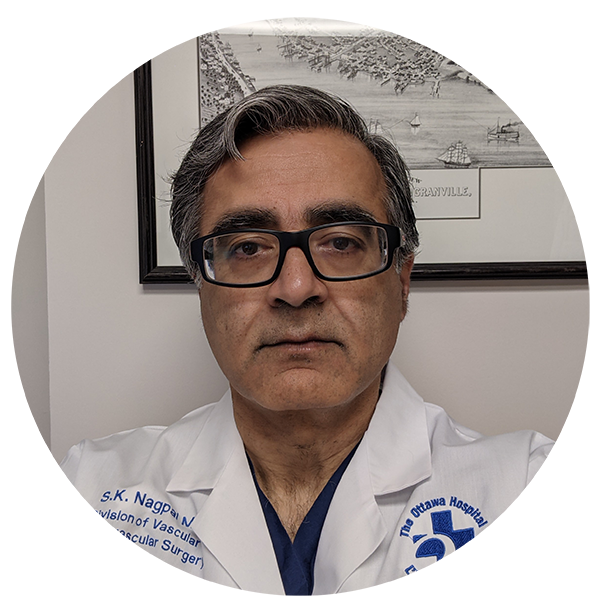
As the Chief of Vascular and Endovascular Surgery at The Ottawa Hospital since 2012, Dr. Nagpal is leading what is now considered a renowned vascular surgical team that is on the cutting edge of new surgical techniques.

Dr. Nagpal is also a Clinical Investigator at the Ottawa Hospital Research Institute, and both his commitment to research and excellence in care are changing the outcomes for patients at our hospital.

Q: When did you realize you wanted to become a doctor, or, how did you end up as a vascular surgeon?

A: I have always been interested in the sciences, starting back in middle and high school, and consistently received encouragement from teachers to pursue higher education. Growing up in a small town in Nova Scotia, I interacted with my family doctor and remember being quite impressed with his calm demeanour and temperament. He was a person that one would clearly want to emulate.

Going on to Dalhousie University and having discussions with students at the medical school, I knew this profession would be challenging and fulfilling. After finishing Dalhousie Medical School, I worked as an emergency doctor for approximately four years before returning for general surgery training. During the general surgery residency program, my favourite rotations were in vascular surgery. Performing operations on blood vessels can be quite technically challenging but ultimately quite satisfying as the results are often immediate. Also, vascular patients tend to be elderly, and this patient population tells the most extraordinary personal stories during clinic visits!

Q: What is something unusual or surprising about the field of vascular surgery?

A: The field of vascular surgery has undergone nothing short of a revolution in the past 10 or 15 years. Vascular procedures that were done with major operations requiring large incisions and significant duration of stay in the hospital can now be done by minimally invasive procedures, called endovascular therapy. These patients often are home within a day or two. Though less physically intrusive, a minimally invasive surgery may not compare favourably to a more complex open procedure.

This conundrum, which procedure is best for a particular patient on a long-term basis, has been a major challenge for vascular specialists. We were fortunate at The Ottawa Hospital to acquire one of the first advanced hybrid operating rooms which allows us to do both minimally invasive and open procedures on the same patient at the same time. This has allowed us to become a national leader in these innovative procedures.

Q: You worked on Mina Jean King’s case. What made her case challenging or unique?

A: Mina’s particular situation showed significant blockages in both legs. We were able to improve the circulation on her right leg with endovascular therapy, but on her left leg, where she had developed limb threatening ulcers (open non-healing areas on skin), endovascular therapy had not worked. She had a significant risk of losing her left leg to an amputation, which would have immensely affected her quality of life.

Performing complex bypass procedures in this age group requires a team approach with the assistance of skilled anesthetists, nurses, surgical teams, and postop care. Fortunately, at The Ottawa Hospital, we have these skilled people in abundance. In particular, this bypass required us to sew blood vessels two millimetres in diameter in the lower part of her leg. This procedure took approximately four and a half hours, and she pulled through with flying colours thanks to the whole team.

Q: The bypass surgery you had to do on one of Mina Jean King’s legs was incredibly complex. Why do you think The Ottawa Hospital has had remarkable success in these complex bypass surgeries?

A: The Ottawa Hospital performs more complex bypass procedures than any other hospital in Ontario. The Division of Vascular Surgery at our hospital is committed to limb preservation as a major focus. We have created a Limb Preservation Clinic, which is being used as a model for care throughout Ontario and Canada. Again, this requires a significant team approach that includes experts in wound care, infectious disease specialists, plastic surgeons, and orthopedic surgeons. This collaborative approach has allowed patients to receive expert medical care by multiple specialists on one visit. Ottawa has one of the lowest amputation rates following bypass surgery in Ontario. The coordinated care and follow-up is done through the Limb Preservation Clinic is a major reason. The division is initiating a limb preservation clinical fellowship to teach young vascular surgeons complex operative and endovascular techniques, optimizing wound care and risk factor management. Hopefully, the excellent results seen at our hospital can be taught and spread throughout Ontario and Canada.

Q: What is The Ottawa Hospital doing in vascular research that is exciting or groundbreaking?

A: Vascular research is also a significant focus for the Division of Vascular Surgery and undoubtedly has improved patient care. Multiple impactful research endeavours have allowed the division to become a national leader for vascular research and innovation and some recent research projects have received national awards and international recognition.

New exciting projects underway which have received significant grant funding include: a research program in peripheral vascular disease, quality control for access to vascular risk factor management, artificial intelligence in the vascular operating room, and assessing mindfulness to improve mental health in surgical residents. This is a glimpse of the multiple projects that are ongoing in the division.

Q: How important is community support/donation for pushing research forward?

A: Funding for ongoing innovative research is a persistent concern for any academic division. This is especially true for a busy surgical division devoted to patient care. Community support allows us to leverage research support for innovative ideas originating from surgeons and residents. This research support is invaluable from the onset of the research idea to the completion of written manuscripts. We are thankful to the donors who have allowed us to maintain and improve our research focus over the years. The costs of research continue to rise, and the need for new resources and support also remain.

Q: The Ottawa Hospital is currently working towards the creation of a new, state-of-the-art health and research centre to replace the aging Civic Campus. What will this new hospital mean for your patients?

A: We have reviewed the plans for the New Campus Development and research centre — it is exciting to be involved in the planning of this new modern health facility. Vascular patients will be well-served in this new facility through integrated outpatient care, including our limb preservation clinic, collaborating specialties, and our vascular diagnostic centre. They will receive their vascular tests and clinic appointment in the same location, allowing prompt diagnosis and therapeutic decisions. The new operating rooms will have advanced hybrid endovascular and operative infrastructure allowing us to maintain and continue to lead with innovative procedures advancing patient care.

Q: What keeps you motivated during stressful times as a vascular surgeon at The Ottawa Hospital?

A: On a professional level, vascular surgery can certainly prove taxing at times. A complex lifesaving operation lasting four to five hours can proceed successfully only to have the patient suffer complications due to the magnitude of stress to the body. This can certainly take a professional, and personal, toll as many of our patients have pre-existing conditions.

Vascular surgery is also a tremendously satisfying specialty, knowing you had a part to play in saving many lives and limbs, indeed this is the primary motivating factor for the long hours and stressful times.

Dr. Carolyn Nessim is a Surgical Oncologist at The Ottawa Hospital, as well as a Clinician Investigator at the Ottawa Hospital Research Institute (OHRI).

Before arriving at our hospital in 2013, her training took her from Montreal to Toronto and even as far as Melbourne, Australia. While she specializes in soft tissue sarcoma, melanoma, and gastric cancer, her expertise is wide-ranging as she collaborates with other researchers in addition to treating patients.

Dr. Nessim also has rhythm. In 2018, she was one of a handful of physicians who competed on the dance floor in front of a sold-out crowd of 800 for Dancing with the Docs, a fundraising event that raises funds for patient care and research at our hospital.

Q: When did you realize you wanted to become a doctor? How did you end up in oncology? 

A: I have wanted to be a doctor since I was seven years old — it’s as if it was a calling. In my 20s I had a personal health scare, and the nicest doctor took all my fears away with a simple conversation. I remember thinking, “I want to do that for people too.” By my second year of surgical residency, I knew I wanted to specialize in oncology.  I was fascinated by the complex tumours and surgeries and new therapies that were changing the face of cancers, but more importantly, I was moved by the relationship that develops with patients and how rewarding the work is. I’m often asked why I chose cancer because people assume it must be so sad. But on the contrary — it is a privilege. To cut is a chance to cure and patients unconditionally trust us to take care of them.

Q: What is the most interesting thing you have learned during your time as a surgical oncologist?

A: For patients we cannot cure we still provide support and empathy through a difficult journey, so I believe we still help in those cases as well. No one lives forever, but how we live our journey is what will make the difference, so I believe in hope and positive thinking.

Q: What innovations have you seen in the field of oncology since you started?

A: The role of immunotherapy in cancer is revolutionary. It’s a type of treatment that boosts your immune system to fight off the cancer. Although it does not work in all cancers, for others it has turned metastatic patients that used to die within six months to now live for 5-10 years and beyond. It has taken decades to perfect and in 2018, it won the Nobel Prize.

Q: What is The Ottawa Hospital doing in oncology that is exciting or groundbreaking?  

A: I have done some translational clinical research with Michele Ardolino, Jean-Simon Diallo, and Luc Sabourin at the Ottawa Hospital Research Institute to better understand the genetics and biology of both melanoma and sarcoma and how they respond to oncolytic viruses or why they resist to immunotherapy. It’s very exciting work.

Q: You helped uncover Bryde Fresque’s diagnosis of a rare pheochromocytoma, why was this diagnosis a challenge?

A: In Bryde’s case, he had a spontaneous rupture which led to a large hematoma that hid the underlying tumour on imaging. Also, most pheos release adrenaline which you can detect in a 24-hour urinary test, but Bryde’s was non-functional making the urine tests negative. These factors made the diagnosis more difficult to make. Eventually we could see a mass on the imaging, and it was clear the only next best step was to remove it.

Q: The surgery he needed to save his life was incredibly complex, lasting 12 hours. Explain why. 

A: The tumour was quite large —over 20cm — and very inflamed because of the bleeding. His tumour was also attached to several organs which required what we call a multi-visceral resection en bloc (removal of organs that are touching). This takes time as it involves very careful dissection of large vessels that we do not want to injure. We removed Bryde’s tumour en bloc with the kidney, adrenal, spleen, distal pancreas, colon and diaphragm and then reconstructed the diaphragm and colon. Most sarcoma surgeries take anywhere from 5-24 hours. Some can take even longer — over 48 – hours.

Q: What makes rare cancers, like pheochromocytomas such a challenge to diagnose and treat? 

A: The reason rare cancers are hard to treat and diagnose is because we need more investment in research.  Also, the rarer the cancer the less we are able to run large randomized clinical trials, because there are so few patients. We need more international collaboration for rare cancers to increase the number of patients to better understand these diseases and how to manage them. In the last ten years, we have created an international research collaboration for sarcoma called the Trans-Atlantic Australasian Retroperitoneal Sarcoma Working group of which I am the Chair of the Research Evaluation Committee. This has made a huge difference in sarcoma research. It includes experts from around the world designing research studies and clinical trials and it will change the face of sarcoma research.

Q: What is the most gratifying part of your role as a surgical oncologist at The Ottawa Hospital? 

A: My relationship with my patients. It is the best thing ever. I am inspired by their strength, motivation, and humility. Being even just a small part of their journey is the most fulfilling and gratifying part of my job and pushes me out of bed every morning to come to work.

Q: In your opinion, how important is support from the community in advancing cancer research?

It is very important. If there were more awareness and more community support, we could expand our research and study more about diseases like rare cancers.

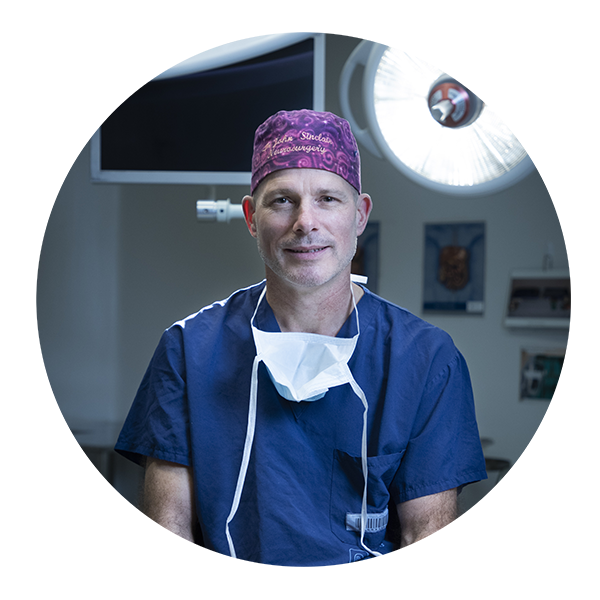
The Ottawa Hospital was fortunate to welcome renowned neurosurgeon Dr. John Sinclair back to Ottawa 2005, following two fellowships at Stanford University in California. As the Director of Neurosurgical Oncology and the Director of Cerebrovascular Surgery, he is an expert resource for our patients facing brain tumours, including glioblastoma multifome.

Dr. Sinclair is an innovator and always on the lookout for the latest treatment options for our patients. It was this drive that helped bring the CyberKnife, Advanced Awake Craniotomy techniques and most recently Fluorescence-Guided Surgery to our hospital. With tools like these at their disposal, Dr. Sinclair and his colleagues have increased survival rates for our brain tumour patients.

Q: Why did you choose to work at The Ottawa Hospital?

A: I grew up in Ottawa. The sense of community here is strong. I wanted to be a part of that community. I felt that I could make a difference by helping to develop outstanding care for our patients in the community and beyond. I have treated a number of patients who I have known from my years growing up in Ottawa. There is a bond that builds trust and hope in patients when you have a common connection. Ottawa is that connection for me.

Q: As the Director of Neurosurgical Oncology what, in your opinion, sets The Ottawa Hospital apart from other hospitals?

A: The thing that sets us apart is the incorporation of awake surgery and advanced mapping for the resection of most brain tumours and more recently Fluorescence Guided Surgery. These innovations place us alongside our Ottawa Hospital colleagues in cancer treatment and research within the complementary specialties of neuro-oncology, neuroradiology, neuropathology, neurophysiology and neurological oncology. These two advances in particular have allowed a wider scope of a patient centered focus as we collaborate closely through all aspects of care and treatment.

Q: You were instrumental in bringing the community-supported fluorescence-guided microscope to our hospital. This microscope illuminates malignant brain tumours during surgery allowing you to successfully remove more of the tumour. How has this microscope impacted our patients with brain cancer?

A: Without this microscope, we would not be able to do Fluorescence Guided Surgery (FSG). FSG allows for maximal safe resection of malignant tumours which in research has proven to increase length of time to recurrence and overall survival rates. Without a doubt, this offers our patients a better chance to fight against brain cancer.

Q: Another piece of equipment made possible thanks to donor support is the CyberKnife. How has the CyberKnife technology helped patients of The Ottawa Hospital over the past decade?

A: Over the past decade, we have been able to treat thousands of patients using CyberKnife. It allows for a targeted approach to radiation treatment resulting in decreased side effects and decreased risk to the patients. This precision treatment also typically allows for shorter treatment time resulting in viewer visits to the hospital.

Q: You removed Stefanie Scrivens’ grade 2 oligodendroglioma brain tumour through a successful awake surgery, and she didn’t need chemo or radiation. What made this incredible outcome possible?

A: Using advanced subcortical mapping during Stefanie’s surgery allowed us to provide maximal resection of the tumour, taking a rim of “normal” tissue where the tumour had been. This was done in hopes of removing any microscopic tumour cells that extended beyond the tumour. By doing so we were able to indefinitely postpone radiation and chemotherapy.

Q: The Ottawa Hospital has incorporated Canada’s advanced brain mapping techniques to help during awake brain surgery. How does this mapping system help brain surgeons?

A: Traditional approaches to awake craniotomy deal with basic brain function; speech and movement. In many cases this is sufficient. Advanced cortical and subcortical mapping allows testing of advanced brain function that can impact higher brain function, such as cognition, personality and visual perception. The ability to map these functions allows us to safely preserve brain function; improving outcomes and the quality of life for patients. With basic mapping it is often necessary to leave a portion of tumour behind rather than continuing surgery in these eloquent areas.

Q: The Ottawa Hospital is currently working towards the creation of a new, state-of-the-art health and research centre to replace the aging Civic Campus. What will this new hospital campus, which will be the most technologically advanced facility in Canada, mean for your patients?

A: The new hospital campus will allow us to build from our strong foundation, a centre that will provide our patients with multidisciplinary care that will bring together all facets of healthcare. A centre like this will attract world-class physicians and care teams. It will help to advance treatment and research within our community. In doing so we will be able to provide a centre of excellence. This is a perfect opportunity to really bring patient care to the highest level.

Q: What message do you want to convey to your patients with brain tumours?

A: Quoted statistics often reflect dated technology and treatment protocols and new advances in treatment are always occurring and evolving. Our patients need to keep that hope and our community must foster that through continued support of The Ottawa Hospital in order for this to become a reality in the years to come.

Go behind the scenes with Dr. John Sinclair in episode 35 of Pulse Podcast.

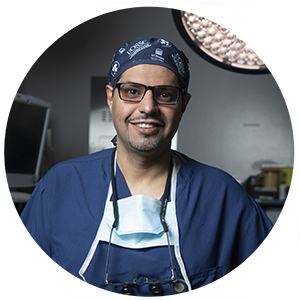
Dr. Fahad Alkherayf is a skull base surgeon at The Ottawa Hospital.

Dr. Fahad Alkherayf is the Director of the Clinical Research Program in the Neurosurgery Division of The Ottawa Hospital. As a neurosurgeon, he specializes in minimally invasive surgeries, which use much smaller incisions than traditional surgeries. As a result, they can mean less pain, lower chance of infection, and quicker recovery time. As part of a highly skilled team at The Ottawa Hospital, Dr. Alkherayf is broadening the horizons in neurosurgery treatment and research — not just in Ottawa, but across Canada.

Q: How did you decide to go into the field of neurosurgery?

A: In my Grade 7 science class, we learned about the human body and how all the systems function together. It really started my interest in medicine, especially the brain. There were three of us in that class who were very close friends, and we shared this interest. All three of us became doctors: one is a psychiatrist, one a radiation oncologist. I went to medical school based on this, and during my schooling I spent time in neurosurgery and realized this would be my future.

Q: What have you learned since becoming a neurosurgeon?

A: I have learned that despite what the textbooks show and say about the brain, in real life each patient is unique, and what works for one patient might not work for another. This has inspired me to individualize each of my patients’ care.

Neurosurgery is also evolving at a fast pace, and a lot of the equipment we now use was not invented or used when I started in the field. A lot of historical neurosurgical procedures have been replaced with modern techniques.

Q: You used minimally invasive surgery to remove a meningioma tumour from behind Michele Juma’s eye. How did these new techniques help her?

A: Michele came to see me almost blind because the tumour was attached to her optic nerve. Identifying the margin between the tumour and the nerve without causing damage to her nerve was one of the biggest challenges in her surgery.

This type of tumour is not new, the presentation is not new, but the treatment is relatively new. We used to do craniotomies, which involve a big incision in the skin. You need to remove part of the skull, go underneath the brain, lift the brain up, and then work all the way to the centre and remove the tumour, aiming not to injure any of the structures around itThe challenge with that is it’s a long path, and it’s through a really big incision. We know with these, there is a higher risk of inuring the optic nerve.

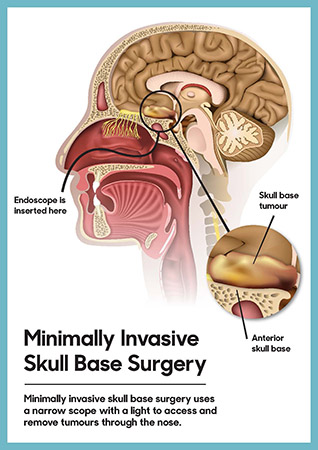
With patients like Michele, now instead of going through the old, traditional way — going through the scope, and lifting the brain up — we go through the nose.

Minimally invasive skull base surgery uses a narrow scope with a light to access and remove tumours through the nose.

Q: You also use a unique technique you call “vision monitoring” during certain minimally invasive surgeries like Michele’s. Can you talk about that and what else The Ottawa Hospital is doing in neurosurgery that is exciting or groundbreaking?

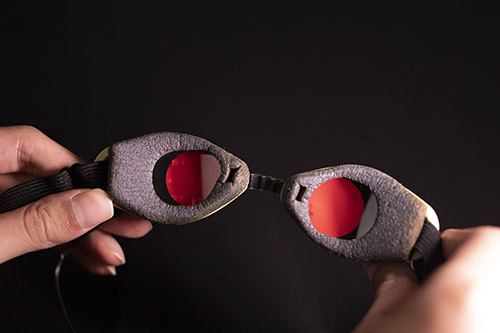
Continuous evoked visual potential goggles are used by surgeons during some brain and skull surgeons to monitor a patient’s vision and avoid damaging the optic nerve.

A: The vision monitoring is teamwork where a neurophysiologist continuously monitors any changes in the patient’s vision during the surgery. This technique is done by applying goggles — similar to swimming goggles — over the patient’s eyes, which send signals through their eyes, and then we record the response from the patient’s vision centre. This allows the neurophysiologist to monitor any changes to the patient’s vision happening during the surgery. This live feedback helps the surgeon to achieve maximum resection (or removal) of tumours while minimizing the risk of injury to the visual pathway.

I am proud that this technique was significantly modified by our team here at The Ottawa Hospital. In addition to this unique technique, at The Ottawa Hospital we have advanced equipment including 3D endoscopes, along with techniques to inject the tumour with certain dyes to allow the tumour to be better visualized during the surgery.

Q: The Ottawa Hospital is currently working towards the creation of a new, world-class health and research centre to replace the aging Civic Campus. How will this new hospital campus, which will be the most technologically-advanced facility in Canada, make a difference for our neuro patients?

A: The new hospital campus will have the state-of-the-art technology that will advance the focus on individualized patient care.

The “one-model-fits-all” approach is changing in neurosurgery. Current research is focussing on individualized patient care. I see a future where each patient will have their surgery planned specific to their situation and needs — where artificial intelligence techniques would be part of planning for patient surgery.

Q: Why did you choose to work at The Ottawa Hospital instead of a different hospital?

A: One of the biggest advantages of The Ottawa Hospital is that all of us are connected. What happened in Michele’s case, for example, is that everything could go very quickly, because we are all in one centre. We are more advanced because we’re able to work as a group. We have brought all the expertise under one umbrella here.

I am a strong believer that the key thing for success is having a collaborative and supportive work environment. Of the many offers I received early in my career, The Ottawa Hospital, together with The Ottawa Hospital Research Institute, were the right fit for me. This kind of workplace, and the great city of Ottawa, was the best decision for my family.

Q: Where would we find you outside of work?

A: Depending on the time of year, you can find me playing soccer, hiking, camping with the kids, or taking care of the garden.

Q: What is something about you people might not know?

A: I have arachnophobia.